
A dripping ceiling is more than an annoyance—it’s a warning sign. But a leak in your fibreglass roof doesn’t automatically mean a £5,000 replacement bill. Forget the overhaul; think surgical strike. With the right technique, you can perform a professional-grade fibreglass roof repair that restores its integrity and stops leaks for good.
This is your guide to fixing cracks, pinholes, and damage yourself, saving you a fortune and giving you back a bone-dry, reliable roof. Let’s get it done.
Stop the Leak: Is Your GRP Roof Salvageable?
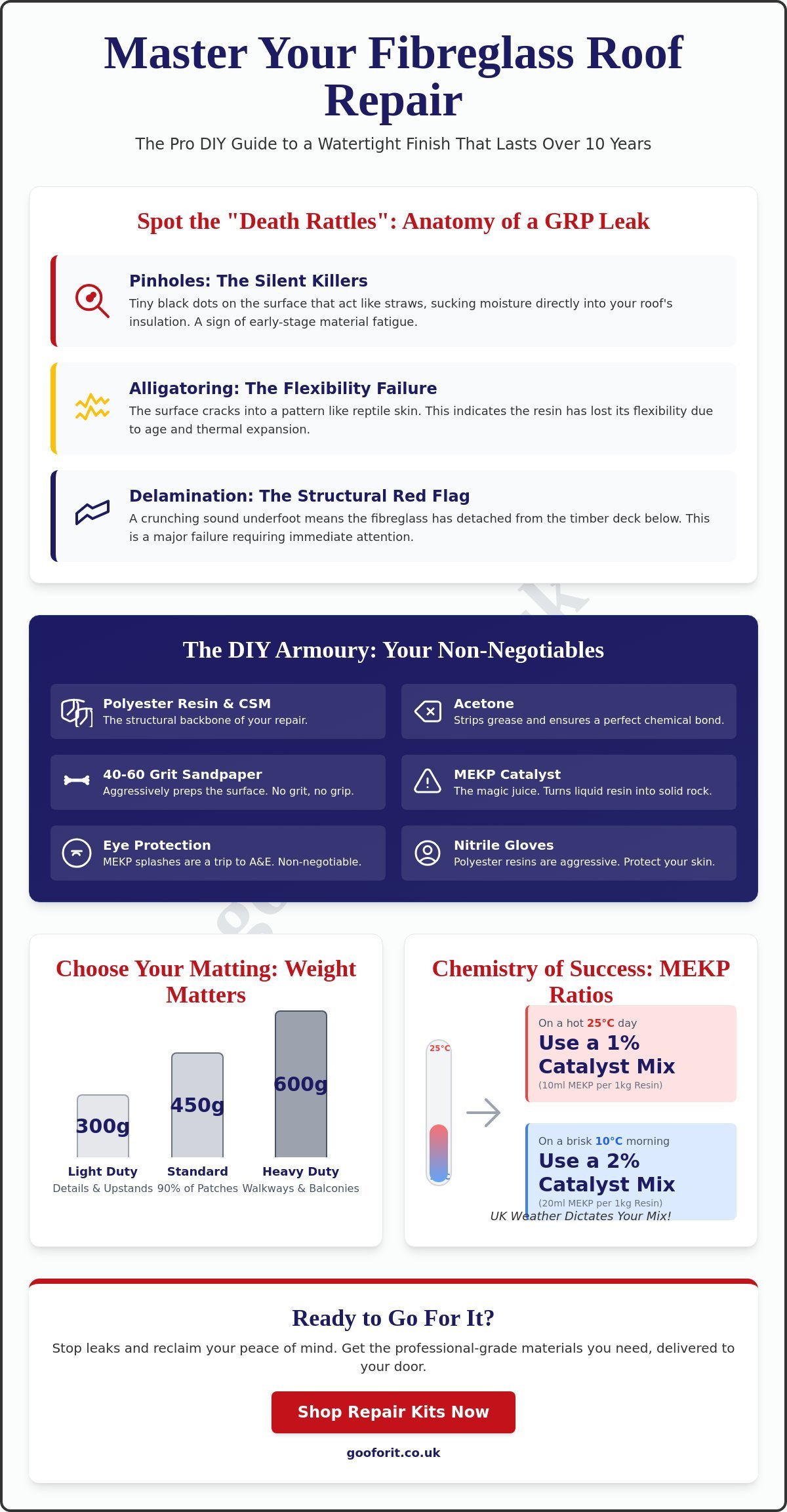
Glass Reinforced Plastic (GRP) is tough, but not invincible. Years of British weather, UV exposure, or a poor initial installation can lead to failures. You’re likely dealing with one of three culprits:
- Pinholes: Tiny black dots that signal the topcoat is failing, letting water seep into the laminate.
- Cracks: Often called “alligatoring,” these splits show the roof has lost its flexibility and is under stress. You can find out more in our guide to fixing fibreglass roof cracks.
- Delamination: The GRP has lifted away from the timber deck, creating a dangerous air gap.
Before you buy any materials, perform the one critical test. Carefully press on the area around the leak. If the timber deck beneath feels firm, your roof is a prime candidate for repair. If it feels soft, spongy, or rotten, a patch won’t save it. You’re looking at a bigger job.
The DIY Armoury: Essential Repair Tools
A professional finish comes from professional prep. You don’t need a workshop full of gear, just the right essentials to create a permanent chemical bond. If it isn’t clean, it won’t stick.
- Aggressive Sandpaper (40-60 grit): To key the surface properly.
- Acetone: The only cleaner that will strip waxes and grease for a true bond.
- GRP Roofing Resin & Catalyst: The core of your repair.
- Chopped Strand Mat (CSM): 450g is the go-to standard for flat roof patches.
- Safety Gear: Nitrile gloves and eye protection are non-negotiable when handling resins.
Step-by-Step: The Professional Fibreglass Roof Repair Method
Follow these steps precisely. Preparation is 90% of the win. Rushing it will guarantee failure.
- Sand the Surface: Using your sandpaper, grind back the damaged area and extend about 10cm around it. You must remove the topcoat entirely until the surface is dull, white, and dusty. This “key” is what the new resin will grab onto.
- Clean with Acetone: Wipe the entire sanded area with a cloth soaked in Acetone. Do not skip this step. It removes invisible contaminants that will prevent the new resin from fusing with the old fibreglass.
- Apply the First Resin Layer: Mix a small amount of resin and catalyst according to the manufacturer’s instructions (this is temperature-dependent). Brush a generous layer onto the prepared area.
- Lay and Consolidate the Matting: Place a pre-cut piece of chopped strand mat onto the wet resin. Apply more resin on top, using a stippling motion with your brush or a paddle roller to drive it into the fibres. Work until all air bubbles are gone and the matting turns translucent.
- Apply the Topcoat: Once the resin patch has fully cured (it will be hard and no longer tacky), give it a light sanding. Apply a matching flowcoat (topcoat) over the repair to protect it from UV damage and provide that final, seamless waterproof finish.
Future-Proofing Your Fix
A successful patch stops the immediate leak, but it can also be a sign of the roof’s age. If you’re seeing cracks and issues across multiple areas, a full restoration may be a smarter move than chasing individual repairs. For older roofs with widespread wear, a complete liquid overlay provides a new, seamless membrane that can add another 20 years of life for a fraction of the replacement cost.
Explore your options with a dedicated GRP Roof Restoration Coating to turn a temporary fix into a long-term investment. Don’t just patch it—make it bulletproof. Go for it.