
You invested in GRP for its 30-year promise, yet here you are, spotting pinholes and watching your sleek finish turn into a dull, brittle relic. It’s a frustrating reality for thousands of homeowners dealing with aged installations across the UK.
Don’t call the demolition crew just yet. You can master the art of GRP restoration and stop leaks fast with our guide. We’re stripping away the jargon to give you the raw, DIY truth about saving your overhead. We’ll show you how to kill the cracks, restore that vital UV protection, and keep your bank balance intact by avoiding a £4,500 full rebuild. Let’s go for it and get your home watertight again.
Key Takeaways
-
Stop the noise and save thousands of £ by choosing GRP restoration over an expensive and unnecessary full replacement.
-
Learn exactly why your fibreglass roof fails and how to tackle common leaks with high-impact, permanent DIY solutions.
-
Master the pro-level preparation secrets-from deep cleaning to sanding-that ensure your new coating creates a flawless, long-lasting bond.
-
Discover a market-disrupting restoration system designed for DIYers who want elite results without the professional price tag.
-
Transform your worn-out roof into a shield against the UK weather with our step-by-step application guide.
Table of Contents
What Is a Fibreglass Roof and Why Do They Fail?
Your roof should be a fortress. A fibreglass roof, or GRP (Glass Reinforced Plastic), is exactly that. It is a high-impact blend of liquid resin and glass fibres that creates a seamless, waterproof skin over your home. It is designed to last 30 years or more. But even the toughest tech can glitch. In the UK, our wild temperature swings and relentless rain test every square inch. Failure isn’t just a leak. It’s a total vibe shift. You’ll see dull patches, hairline cracks, and a general loss of that factory-fresh gloss before the water actually finds a way in.
Understanding the tech is the first step toward a fix. To grasp the basics of the material, what is fiberglass? It is essentially reinforced plastic that provides incredible strength without the weight of traditional materials like lead or felt. When it’s applied correctly, it’s invincible. When it’s rushed, it’s a ticking clock. Most failures in the UK stem from poor original installations or decades of UV battering that finally breaks the chemical bonds.
The Anatomy of GRP Roofing
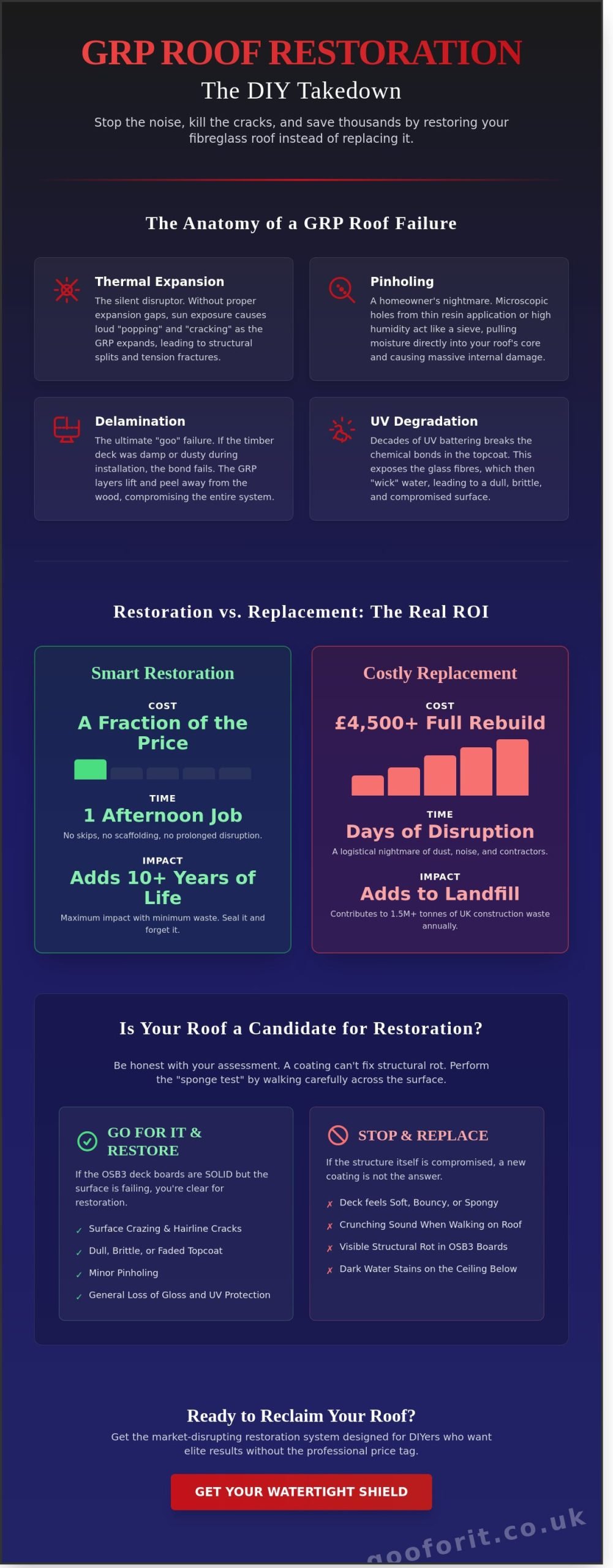
A solid fibreglass roof relies on three critical layers working in total harmony. The deck is your foundation, typically made of 18mm OSB3 structural boards. On top of that sits the laminate. This is the structural muscle of the system, where glass strands are saturated in resin to create a rigid plate. Finally, you have the topcoat. This pigmented layer is your first line of defence. It blocks UV rays and seals the entire system against the elements. If the topcoat fails, the glass fibres underneath start to "wick" water, pulling moisture directly into your roof’s core.
Common Failure Points in UK Homes
Thermal expansion is the silent disruptor for many UK homeowners. As the sun hits the surface, the GRP expands. If the installer didn’t leave proper expansion gaps at the edges, the roof will "pop" and "crack" like a bowl of cereal. That noise is the sound of tension. Over time, that tension leads to structural splits that no amount of paint can hide.
Pinholing is another nightmare that causes massive internal damage. These tiny, microscopic holes appear if the resin was applied too thinly or if the humidity was too high during the install. They look like pinpricks but act like a sieve. Finally, watch out for delamination. If the timber deck was damp or dusty when the resin went down, the bond fails. The layers lift and peel away from the wood. It’s a mess, it’s noisy, and it’s a sign that your roof has lost its grip on reality. Standing water accelerating this process is a serious concern; understanding flat roof ponding prevention is essential to stop pooling water from compounding these failure points before they become structural disasters.
Can You Repair a Fibreglass Roof Instead of Replacing It?
The short answer? Absolutely. Stop the noise. Stop the panic. Your fibreglass roof isn’t a write-off just because you spotted a leak or some hairline cracks. Most homeowners get bullied into a full replacement by contractors looking for a massive payday. A total tear-off and reinstall can easily cost you £4,500 or more for a standard double garage. Restoration costs a fraction of that. This isn’t just a budget fix; it is the disruptive choice for smart owners who value their cash and their time. Choosing "GooForIt" restoration over a full replacement means you are opting for speed, efficiency, and results without the construction drama.
Restoration vs. Replacement: The Real ROI
Time is the one thing you can’t buy back. A full replacement involves skips, scaffolding, and days of grinding dust. It is a logistical nightmare. A restoration coating skips the chaos. You can apply a high-performance liquid membrane over your existing GRP in a single afternoon. This move adds 10+ years of life to your structure instantly. Think about the environmental impact too. Over 1.5 million tonnes of construction waste hit UK landfills every year. Why add your old roof to the pile when you can seal it and forget it? It is about maximum impact with minimum waste. You save thousands of pounds while keeping your home watertight. For a detailed breakdown of the costs and benefits, our GRP Roof Restoration Coating restore vs. replace guide gives you everything you need to make the right call.
When Is a Roof "Too Far Gone"?
You have to be honest with your assessment. If the OSB3 boards underneath are rotting, a coating won’t save you. Perform the "sponge test" by walking across the surface. If the deck feels soft, bouncy, or makes a crunching sound, the structural integrity is compromised. This often happens when moisture gets trapped in the system. Understanding how roof ventilation affects performance is vital here. Trapped heat and condensation can kill a roof from the inside out long before the surface fails. Poor drainage and standing water on flat roofs adds roughly 5 pounds of dead weight per square foot for every inch of depth, silently accelerating board rot and delamination. However, if the boards are solid but the surface is crazing, you are in the clear. Surface cracks are an easy win. They look scary, but they are usually just cosmetic top-coat failures that a high-quality seal can fix.
-
Structural Rot: If you see dark water stains on the ceiling below, check the boards. Soft wood means replacement.
-
Surface Crazing: Fine, spider-web cracks. Perfect for restoration.
-
Delamination: If the glass mat is lifting from the wood, you need to pin it back before coating.
If your deck is structurally sound, do not let anyone talk you into a £5,000 bill. Most common issues are a perfect match for a fibreglass repair kit. It is the ultimate weapon against a leaky GRP system. Ready to take control of your home? You should GooForIt and start your restoration today.
The Best DIY Fixes for Common GRP Roof Problems
Most DIY failures happen because people skip the basics. Preparation is 90% of your success. If the surface isn’t clean, your new resin won’t bond. It’s that simple. Scrub it. Dry it. Kill the grime. Any grease left behind will disrupt the chemical bond and lead to total failure.
Don’t settle for cheap hardware store paints. They lack the muscle for real weather. High-build coatings are the gold standard. They add thick, durable layers that move with your building. UV protection is the secret weapon here. Without it, the sun turns your repair brittle in 24 months. A professional-grade fibreglass roof paint ensures your fix lasts 10 years or more. Understanding the original Fibreglass (GRP) Flat Roof Construction helps you see why these layers matter. Build it strong. Make it loud. High-build options provide a 2mm to 3mm shield that cheap alternatives can’t match. For a complete set of DIY roof maintenance tips that cover everything from GRP to encapsulation, our fearless restoration guide gives you the full picture before you pick up a roller.
Fixing Cracks and Splits
Cracks are structural noise. You can’t just paint over them. Grab the sandpaper. Sand the area back until you see a fresh "key" for the resin. This creates the mechanical grip you need. Lay down a reinforcing scrim. This mesh bridges the gap. It adds the tensile strength that stops the split from returning. Apply your resin over the scrim until it’s fully saturated. Finish with a matching topcoat. This creates a seamless, waterproof barrier that looks factory-fresh. For a complete walkthrough of every crack and split scenario, our fibreglass roof repair ultimate DIY guide gives you the step-by-step blueprint to obliterate leaks and restore a professional finish that lasts over 10 years.
Dealing with Pinholes and Porosity
Pinholes usually happen because the original topcoat was applied too thin during installation. Water finds these holes. It creates a slow-motion disaster for your decking. Use a high-performance GRP roof restoration coating to fill this noise. Don’t be shy with the product. Use the flood coat technique. You aren’t just painting. You are saturating the surface. This creates total peace of mind. It turns a porous mess into a solid, impenetrable shield. Impact matters. Make your fibreglass roof bulletproof against the British rain. It’s about creating a vibe of total reliability.
How to Apply a GRP Restoration Coating Like a Pro
Stop settling for a leaky mess. Follow these five steps to lock in a professional finish that lasts.
-
Step 1: The Deep Clean. If there is moss, lichen, or dust, the coating won’t stick. Use a stiff brush and a power washer if needed. It must be spotless.
-
Step 2: Sand the Surface. You need to kill the shine. Use 40 to 60 grit sandpaper to key the existing topcoat. This creates the "tooth" required for a solid mechanical bond.
-
Step 3: Acetone Wipe. This is the secret sauce. Wipe the deck with pure acetone. This removes residual wax and triggers a chemical bond with the new layer.
-
Step 4: Apply the Coating. Roll on your Gooforit coating with purpose. Work in manageable sections. Keep your layers even and watch the transformation happen in real-time.
-
Step 5: The Cure. Let the chemistry do the work. Once it’s cured, you’ve got a seamless, waterproof shield. No leaks. No stress. Just pure impact.
Weather Windows: The UK DIYer’s Challenge
British weather loves to ruin a good plan. You need a solid 24-hour dry window. Rain is the enemy of an uncured fibreglass roof. Aim for a day where humidity is below 80%. Avoid the midday sun; it cooks the coating too fast. Stay away from the evening dew; it kills the finish. Use a professional moisture meter to verify the deck is below 5% moisture content before you even open a tin. If it is damp, don’t risk it. Wait for the sun.
Tools of the Trade
You need high-quality solvent-resistant rollers and brushes that won’t melt. Mixing is where most people fail. Use a heavy-duty paint mixer attached to a power drill to ensure the resin and catalyst are fully integrated. Safety is non-negotiable. Wear nitrile gloves and wrap-around goggles. Keep a gallon of acetone on standby at all times. If you get "Goo" on your skin or tools, you need to react fast. Clean up as you go to keep the workspace sharp.
Ready to dominate your DIY project? Go for it and grab the professional gear you need today.
Go For It: Why Our Restoration System Disrupts the Market
Standard roof repairs are a snooze. They are beige, boring, and usually overpriced. We don’t do standard. We do high-impact roof protection that actually works. Most GRP systems fail because they are too rigid for the real world. Our restoration system flips the script. It is designed specifically for the DIYer who wants professional results without the professional price tag. You get the pro finish. You keep the cash. It is a total win.
We built this for the UK climate. Our weather is unpredictable. One day it is a heatwave, the next it is a freezing downpour. This constant shifting destroys inferior products. We formulated our coatings to survive these extremes. We want you to stop the leaks. We want you to kill the noise of rattling layers. Most importantly, we want you to restore the impact of your home. Your fibreglass roof should be an asset, not a headache. We give you the tools to make that happen. If you also have older outbuildings with corrugated sheeting, our asbestos roof repair kit guide shows you how to seal leaks and lock down dangerous fibres without an expensive hazmat contractor.
The GooForIt Advantage
Our formula fights back against the elements. UV rays usually turn a fibreglass roof into a brittle, grey mess within a decade. We stopped that. Our system features maximum UV resistance to prevent future brittleness. It stays looking fresh and performing better for longer. We also solved the flexibility problem. Your house moves. It breathes. If your roof coating is too stiff, it snaps. Our coatings offer superior flexibility to handle thermal movement without cracking. This is engineering for the real world.
Application is a breeze. We stripped away the complexity and the gatekeeping. If you can use a paint roller, you can fix your roof. There is no need for specialized training or expensive machinery. We provide the high-octane solution; you provide the energy. It is about taking control of your property maintenance. No more waiting weeks for a contractor to show up and charge a fortune. You do it on your schedule. You do it right.
Ready to Fix Your Roof?
Don’t wait for the next storm to test your luck. A small leak today is a structural disaster tomorrow. Fortune favours the bold and the prepared. Grab a kit, follow our straightforward guide, and just go for it. We are here to help you disrupt the cycle of constant repairs. Take action. Make some noise. Restore your roof with a system that is built to last through every UK season.
Take the leap today: Shop our GRP Roof Restoration Coatings now!
Stop The Decay And Own Your Space
Your fibreglass roof shouldn’t be a source of constant stress. Most GRP systems fail because they can’t handle the 100 percent UV exposure and thermal movement common in the UK. Industry data suggests a full domestic roof replacement often hits the £5,000 mark. You don’t need to pay that. You can restore it instead. Our specialist UK-formulated coatings are engineered to disrupt the cycle of decay. We provide high-impact UV protection that keeps your GRP flexible and watertight. Our easy DIY application kits mean you don’t need a team of expensive contractors. You just need the right gear and a bit of energy. We’ve stripped away the complexity to give you a professional finish that stands out. Stop letting the leaks win. It’s time to take action and protect your home with a system that actually works. The vibe is simple; fix it fast and fix it right. Don’t settle for a failing roof when the solution is right here. Stop the leaks and restore your GRP roof today; Shop Now!
You’ve got the knowledge. Grab a kit and show that roof who’s boss.
Fibreglass Roof FAQ: Expert Tips and Quick Fixes
How long does a fibreglass roof last in the UK?
A professionally installed fibreglass roof lasts between 25 and 30 years in the UK. This lifespan outshines traditional felt by over 15 years. It’s built to handle heavy British rain and intense UV rays without breaking a sweat. If you maintain it, you’re looking at three decades of solid, leak-free performance. Don’t settle for less. Go for the long game and keep your home bone dry.
Why is my fibreglass roof making a cracking noise?
Your roof is making noise because of thermal expansion and contraction. When temperatures swing by 15 degrees in a single day, the GRP moves. If the boards weren’t installed with a 3mm gap, they’ll creak and pop as they expand. It’s the sound of physics in action. It doesn’t always mean failure, but it definitely kills the vibe. Check your expansion joints to ensure everything has room to breathe.
Can I paint over an old GRP roof?
You can absolutely paint over an old GRP roof to refresh its vibe and restore protection. Use a high-quality GRP topcoat or a dedicated acrylic roof paint for maximum impact. Sand the surface with 40-grit paper first to ensure the new layer sticks. 90% of failures happen because people skip the prep work. Clean it, sand it, and then go for it with a fresh, bold colour.
Is it normal for a fibreglass roof to have pinholes?
Pinholes are never normal and indicate a weak application process. These tiny gaps usually appear when the resin is over-thinned or applied in direct sunlight above 25 degrees. They invite water to seep into the laminate, which can cause 100% saturation of the decking over time. It’s a silent killer for your flat roof. Seal them immediately with a fresh layer of topcoat to stop the rot before it starts.
How much does it cost to repair a GRP roof vs replace it?
A minor fibreglass roof repair typically costs between £300 and £600 for a standard UK terrace. Full replacement is a different beast, usually ranging from £70 to £120 per square metre. Investing £50 in a DIY kit can save you thousands if you catch the cracks early. Don’t wait for the ceiling to drop. High-octane maintenance saves your bank balance and your sanity. If you have other roof types on your property that need attention, learning about a professional-grade asbestos roof repair kit for sealing leaks and encapsulating fibres can save you from a costly demolition bill on those structures too.
Can I use a fibreglass repair kit on a wet roof?
Never use a fibreglass repair kit on a wet roof. Moisture is the ultimate enemy of GRP, causing the resin to turn milky and fail to cure properly. Even 5% humidity on the surface can ruin the bond and lead to total delamination. Use a heat gun or wait for a dry 24-hour window. If you want a result that lasts, the surface must be bone dry. No shortcuts here.
What is the best temperature to apply GRP resin?
The sweet spot for applying GRP resin is between 15°C and 20°C. If it’s below 5°C, the chemical reaction stalls and it won’t set. If it’s above 30°C, the resin cures too fast, leaving you with a sticky mess and zero control. Aim for a dry, overcast day for the best results. Professional installers track the forecast like hawks to hit that perfect window for a flawless finish.
Do I need a primer before recoating my fibreglass roof?
You need a GRP primer if your roof is more than 12 months old. This creates a chemical bridge between the weathered surface and your new topcoat. Without it, the new layer will peel off within 2 seasons. Think of it as the foundation for your roof’s second life. Apply the primer, wait for the tacky stage, and then hit it with the final coat for maximum durability. For a full breakdown of the best products and techniques, our fibreglass roof paint guide for GRP restoration and UV protection covers everything you need to know.