
Your garage roof isn’t a ticking time bomb, even if your late-night Google searches say otherwise. Thousands of UK homeowners assume a grey, corrugated sheet automatically equals a £2,500 professional removal bill and a total site lockdown. You’re right to be cautious about the health risks, but you don’t need to live in a state of paralysis. Learning how to identify asbestos roof sheets is the first step to reclaiming your space and your budget. If your property was built or renovated before the UK’s total asbestos ban in November 1999, there is a chance it’s there. But a chance isn’t a final verdict.
Stop the guessing game and start taking action. We’re giving you the exact visual markers and hidden date-stamps that separate dangerous legacy materials from modern, safe fibre cement. This is the definitive way to check the roof yourself so you can stop worrying and start sealing. We will break down the specific “AC” codes, the “golf ball” surface textures, and the 1999 cutoff rule. It’s time to cut through the noise, protect your bank account, and just go for it. Your home deserves clarity, and your project deserves to move at high-octane speed.
Key Takeaways
- Stop the guesswork. Your UK property’s age is the ultimate shortcut to identifying hidden risks in that grey corrugated roof.
- Master the “golf ball” texture test and check material thickness to finally understand how to identify asbestos roof sheets with total confidence.
- Don’t let fibre cement lookalikes disrupt your plans. Learn to spot the subtle weight and texture cues that separate modern materials from legacy hazards.
- Ditch the jet washer. Put down the drill. Discover the non-negotiable safety rules for managing undisturbed sheets without making a high-stakes mistake.
- Stop the panic. Start the seal. See how bulletproof GRP encapsulation turns a potential nightmare into a maintenance-free, high-impact asset.
Is Your Roof Asbestos? Cutting Through the Noise
Look at your garage. That grey, wavy, corrugated roof is a British icon. It is everywhere. From industrial estates to residential neighbourhoods across the country, these sheets look identical. But there is a hidden story behind that uniform look. For decades, this was the go-to material for every shed, lean-to, and industrial unit in the UK. Now, homeowners are left wondering if they are sitting under a ticking clock or just a piece of history. Learning how to identify asbestos roof sheets isn’t just about safety. It is about taking control of your space and your project.
Between the 1950s and the late 1990s, millions of tonnes of this stuff were pumped into the UK construction market. It was the ultimate building hack. If you want to fix a leak or renovate, identification is your superpower. It changes everything. You stop guessing. You start acting. We are here to help you move from “maybe” to “done.” This is the “Goo For It” mindset: identify the problem, find the kit, and fix the leak with total confidence. Let’s cut through the noise and get the facts straight.
The 1999 Cut-Off Point
The year your property was built or renovated is the biggest clue you have. In November 1999, the UK officially banned the use and sale of white asbestos, also known as chrysotile. This was the final shift for the industry. If your roof was installed after the year 2000, you are almost certainly looking at modern fibre cement. If it’s older, the odds shift. Check your deeds or survey reports. A date before 1999 means you must be alert. White asbestos was the standard for asbestos cement roofing for nearly half a century. Knowing this date is the first step in how to identify asbestos roof sheets accurately.
Why Asbestos was the Favourite Choice
The 1970s building boom had a specific vibe. Everything needed to be fast, cheap, and indestructible. Asbestos fit the bill perfectly. Manufacturers mixed asbestos fibres with cement to create a high-impact material that laughed at the British weather. It was fireproof. It did not rot. It was incredibly durable. That is why these roofs are still standing 50 years later without a hint of structural failure. It was the disruptor of its time, providing massive utility at a fraction of the cost of traditional slate or tile. This durability is exactly why so many of these sheets remain on UK outbuildings today, waiting for a modern fix.
The Tell-Tale Signs: Visual Cues and the AC Secret
Stop guessing. Start looking. Learning how to identify asbestos roof sheets isn’t about guesswork; it’s about spotting the DNA of the material. First, check the texture. If the surface has a dimpled, “golf ball” pattern on the underside, your alarm bells should ring. This honeycomb effect was a byproduct of the manufacturing process used before the 1999 UK ban. Modern fibre cement usually lacks this specific cratered look.
Thickness tells a story too. Asbestos sheets are lean, typically measuring between 5mm and 6mm. Modern alternatives are thicker and more robust. Then there’s the fragility. Asbestos cement is brittle. It doesn’t bend or warp. If a corner has snapped off, look at the edge. A clean, sharp break is a classic indicator. Nature also leaves clues. Lichen and moss thrive on the alkaline surface of asbestos, which often has a pH level above 10. If your roof is covered in “nature’s carpet,” it’s because the chemistry is just right for growth.
Reading the Batch Codes
Get your torch out. Flip your perspective and look at the underside of the sheets, specifically along the high points of the corrugation. You’re hunting for a stamped code. If you see “AC,” that stands for Asbestos Cement. It’s a definitive “yes.” If you spot “NT,” you’re in the clear. That stands for New Technology, meaning it’s a modern, asbestos-free fibre cement sheet. If the stamp is weathered away or buried under 20 years of paint, don’t force it. Refer to the HSE asbestos safety guidance to understand your next move without risking exposure.
The Colour and Texture Profile
The aesthetic is unmistakable. We’re talking a palette of dull grey, blue-grey, or off-white. It’s the classic look of 20th-century industrial Britain. Look closer at any chipped edges. You might see tiny, fuzzy white fibres poking out like miniature needles. That’s the “noise” you don’t want to hear. Speaking of sound, try the tap test. Use a coin or a tool to lightly tap the sheet. A dense, high-pitched “snick” sound often indicates the high-density mineral content of asbestos. A duller thud usually points toward modern materials. If you’re ready to clear the air and make a real impact on your property safety, it’s time to go for it and get a professional vibe check on that structure.
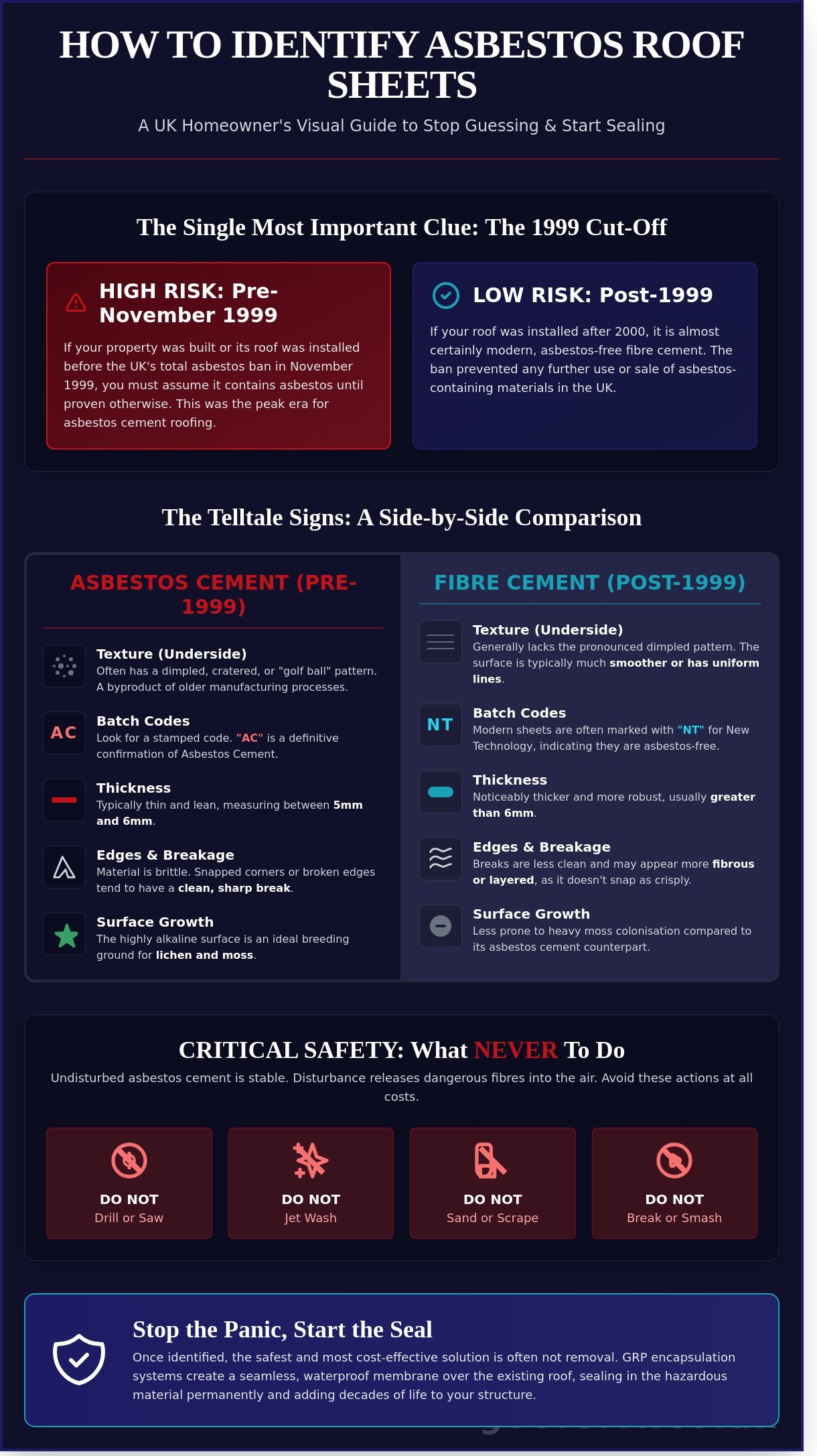
Asbestos vs. Fibre Cement: Spotting the Difference
Think you can tell the difference at a glance? Think again. To the untrained eye, 1970s asbestos cement and modern fibre cement are twins. They share the same corrugated profile. They have the same dull, grey, industrial vibe. But the chemistry inside is worlds apart. Knowing how to identify asbestos roof sheets is about looking past the surface. It is about the tiny details that scream “stop” before you touch a single bolt.
Weight is your first big clue. Modern fibre cement is a heavyweight. It is dense, solid, and feels like a concrete slab. Asbestos cement is surprisingly light for its size. It is brittle. It is thin. If you look at a cross-section of a modern sheet, you might see tiny plastic or organic fibres acting as reinforcement. Asbestos does not do that. It relies on the mineral itself. Then look at the fixings. If you see rusted, old-school hook bolts, you are likely looking at a pre-1999 installation. Modern sheets use galvanised screws with distinctive plastic caps. Check the official HSE guidance on asbestos cement to see how these materials differ in a professional context.
The Lichen Myth Debunked
People say lichen only grows on asbestos. That is a total myth. Lichen grows on anything damp and porous. However, it absolutely loves the texture of old asbestos. Because these sheets have been sitting there since the 1980s or earlier, the lichen has had 40 years to dig deep. It creates a pitted, cratered surface. Never, ever try to scrape it off. Pressure washing or scrubbing lichen off an asbestos sheet is the fastest way to release a cloud of fibres into your lungs. It is high-risk. It is unnecessary. Just leave it.
The Snap Test (Visual Only)
We need to be crystal clear here: do not go around snapping roof sheets. That is a recipe for disaster. But if you are looking at a sheet that is already broken, check the edge. Asbestos cement has a “fuzzy” or “hairy” appearance where it is snapped. Those are the microscopic fibres sticking out. Modern fibre cement breaks more like a digestive biscuit. It is a cleaner, sharper snap. Understanding these visual cues is the safest way to learn how to identify asbestos roof sheets without putting yourself in the line of fire. If it looks fuzzy, back away. Make some noise. Get a pro involved. Go for the safe option every single time.
Safety First: What to Do (And Never Do) Once You Know
You’ve cracked the code on how to identify asbestos roof sheets. Now, keep your hands off. The Golden Rule is non-negotiable: if it’s solid and undisturbed, it’s safe. Asbestos cement only becomes a weapon when you break the bond. It’s a dormant threat that stays harmless until you disturb the peace. Leave it alone and it won’t hurt you.
Avoid the “Don’t” list at all costs. Never jet wash these sheets. High-pressure water is an enemy that blasts fibres directly into your garden and the local air. Forget the wire brush. Put the drill down. These high-impact actions turn a stable roof into a lethal dust cloud. If you feel the urge to clean it, stop. Any abrasion releases microscopic needles that you cannot see but will certainly breathe in.
Assess the condition immediately. Most UK domestic roofs are “non-friable,” meaning the asbestos is locked tight in a cement matrix. It won’t crumble under hand pressure. “Friable” asbestos is the real danger, as it breaks down with a simple touch. If your roof is shedding, cracked, or visibly disintegrating, the vibe has shifted from “manageable” to “hazardous.” For minor repairs on solid sheets, you might handle it with extreme care and the right PPE. For anything else, the risk is too high. Don’t be a hero; call a professional.
The Danger of Dust
Fibres are the silent killers. They only pose a risk when they become airborne and enter your lungs. UK weather plays a massive role here. Decades of rain, frost, and wind erode unsealed sheets. This weathering process loosens the surface over time. During your inspection, keep your distance. Don’t scrape the surface to check the texture. One wrong move releases thousands of fibres that can stay in your system forever. Keep the impact low and the safety high.
Local Regulations and Disposal
UK law doesn’t play around. You can’t just toss asbestos in a standard skip. That’s a fast track to a massive fine and a public health disaster. You must use a licensed waste site. Removal is the most disruptive and expensive option on the table. Professional quotes for a standard single garage often start at £1,500. While you can legally work on your own residential garage roof, you must follow HSE Task Manual A14 to the letter. With disposal fees averaging £250 per tonne at specialist sites, many homeowners choose to seal or over-clad instead. It’s about making a smart, safe impact without breaking the bank.
Stop the Panic, Start the Seal: The Goo For It Solution
Finding asbestos isn’t a death sentence for your garage. It’s a chance to disrupt the cycle of expensive, dangerous removals. Most homeowners panic when they learn how to identify asbestos roof sheets, thinking they need to spend thousands on specialist disposal teams. They don’t. Encapsulation is the high-octane alternative. It’s about working smarter, not harder. By sealing those fibres under a bulletproof layer of GRP Roof Restoration Coating, you eliminate the risk without the £2,500 price tag of a full teardown.
The Goo For It approach is simple. Stop the leak, lock in the fibres, and move on with your life. Our GRP coating creates a monolithic shield that shrugs off the British weather while keeping your family safe. It’s high-impact protection that doesn’t cost the earth. In fact, sealing is the eco-friendly choice. You avoid sending tonnes of hazardous waste to UK landfills, keeping the environment as clean as your conscience.
The Asbestos Roof Repair Kit
Everything you need for a total transformation is packed into one box. We don’t do fluff. Our kit features high-performance Butyl tape for bridging cracks, heavy-duty scrim for reinforcing joints, and the legendary “Goo” coating. While standard DIY paints flake off asbestos, our formula is engineered to bite into the porous surface and never let go. One application extends your roof’s life by 10 years or more. Check out our Asbestos Roof Repair: The Bold Homeowner’s Guide for the full technical breakdown.
Take Action Today
Stop Guessing and Start Sealing
The mystery is over. You’ve spotted the “AC” stamps. You’ve checked the 1999 UK ban date. Now you know exactly what you’re dealing with. Learning how to identify asbestos roof sheets is your power move; it’s the difference between expensive panic and smart action. Don’t touch those power tools and don’t let the noise of a leaky roof disrupt your day. It’s time to lock those fibres down for good.
Our Gloucestershire team lives for this stuff. We’ve developed specialist GRP coatings designed specifically for asbestos surfaces, and we ship them nationwide to every UK postcode. These kits aren’t just temporary patches; they’re high-impact restoration tools trusted by thousands of savvy DIYers across the country. We’ve stripped away the complexity so you can focus on the final result. It’s fast. It’s bold. It works.
Seal your asbestos roof and stop leaks fast with our DIY Repair Kits!
Grab your kit and show that roof who’s boss. You’ve got the knowledge, now go for it.
Frequently Asked Questions
Can I tell if a roof is asbestos just by looking at it?
No, visual checks aren’t foolproof. You need a laboratory test to be 100% sure. Look for a grey, fibrous texture or a “golf ball” dimpled surface on the underside. These are classic signs. If your roof was installed before 1999, treat it as a high risk. Don’t guess with your health. Get a sample tested by a UKAS accredited lab immediately.
What year did they stop using asbestos roof sheets in the UK?
The UK issued a total ban on all asbestos products on 24 November 1999. Anything built or renovated after this date is legally asbestos-free. If your garage dates back to the 1980s or early 1990s, the chances of finding white chrysotile asbestos are extremely high. Check your property deeds for build dates to understand your risk level today.
Is it illegal to have an asbestos garage roof in 2026?
It isn’t illegal to own an asbestos garage roof in 2026. Current UK law allows you to keep existing sheets if they’re in good condition. You only run into legal or safety trouble if the material is damaged, crumbling, or shedding fibres. Don’t panic about the date. Just monitor the vibe of your roof for cracks or heavy weathering every six months.
Can I paint my asbestos roof sheets myself?
You can paint them, but never sand, scrape, or wire-brush the surface first. Doing this releases deadly dust into your lungs. Use a specialised “encapsulation” coating designed specifically for asbestos cement. This seals the fibres and gives your garage a fresh, modern look. Always wear a Grade P3 respirator during the process. Safety isn’t optional. Go for it, but do it right.
What happens if I jet wash an asbestos roof?
Never jet wash an asbestos roof. High-pressure water blasts raw fibres into the air and your garden soil, creating a massive health hazard for you and your neighbours. It’s a breach of the Health and Safety at Work Act 1974. Use a soft-wash chemical treatment to kill moss instead. Keep the pressure off and the safety on to avoid huge cleanup costs and fines.
How much does it cost to identify asbestos professionally?
Is asbestos cement roofing dangerous if it isn’t broken?
Asbestos cement roofing is generally low risk if it’s undisturbed and in good condition. The fibres are locked tightly inside the cement matrix. Danger only strikes when you drill, saw, or break the sheets during a DIY project. If your roof is solid and moss-free, it isn’t making noise. Leave it alone and it’ll leave your health alone. Focus on maintenance instead.
What is the “AC” stamp on my roofing sheets?
An “AC” stamp stands for Asbestos Cement. It’s a definitive marker that your roof contains white asbestos fibres. If you see “NT,” it means “New Technology,” which is the reinforced, asbestos-free version. Learning how to identify asbestos roof sheets starts with checking these codes. Look near the edge of the sheets for these small, embossed letters before you start any renovation work.