
That "minor" patch on your flat roof is just a countdown to a £5,000 structural disaster. You’re likely fed up with the endless cycle of buckets in the hallway and the confusing jargon surrounding DIY flat roof waterproofing that makes your head spin. You want a solution that actually sticks. You need a total vibe shift from "leaky mess" to "bulletproof fortress" before the next British downpour hits your postcode.
It’s time to stop reacting and start disrupting the decay. You can master the art of sealing with high-impact liquid membranes that create a seamless, ironclad shield. We’re talking about a bone-dry home and the massive pride of a professional-grade job without the eye-watering contractor fees. No more noise, no more stress, just pure impact. You don’t need a degree in engineering to protect your space; you just need the right gear and a fearless attitude to get it done right.
This guide strips away the fluff. We’re showing you exactly how to apply liquid power to seal those leaks for good and save your sanctuary from the ground up. Let’s go for it and reclaim your roof today.
Key Takeaways
- Ditch the boiling tar and embrace the liquid revolution. Discover why high-impact, cold-applied membranes are the superior choice for modern UK homes.
- Nail the five-step process for DIY flat roof waterproofing to eliminate vulnerable seams and kill leaks for good.
- 90% of failures start with poor prep. Master the “clean to win” rule and learn how to inspect your roof for structural integrity before you step up.
- Focus on the detail work. Learn how to use speed patches and butyl tape to reinforce joints and bolts for a professional-grade, seamless finish.
- Future-proof your victory. Grab the simple maintenance hacks and post-cure inspection tips that turn a one-time project into a long-term asset.
Table of Contents
-
Stop the Drip: Why DIY Flat Roof Waterproofing is Your Next Power Move
-
Liquid Membranes vs. The Old Way: The Tech Disrupting Roof Repairs
-
The Pre-Game: How to Inspect and Organise Your Roof Like a Pro
-
Maximum Impact: Keeping Your Roof Leak-Free for the Long Haul
Stop the Drip: Why DIY Flat Roof Waterproofing is Your Next Power Move
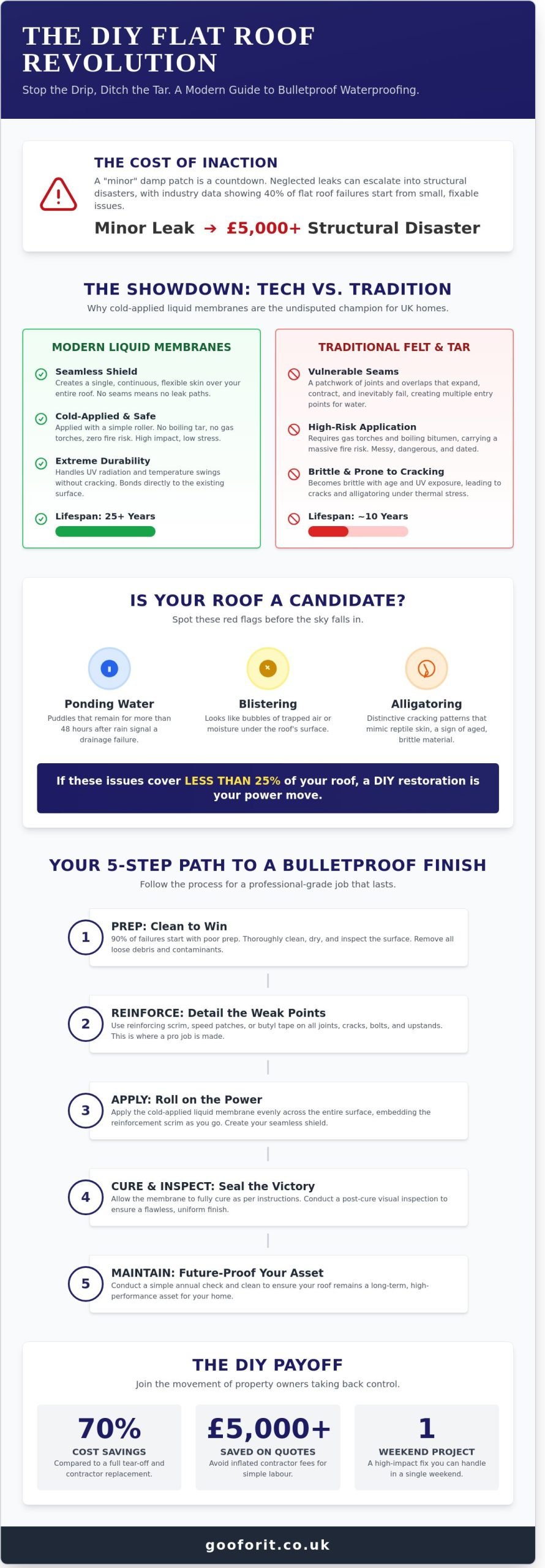
Stop the drip before it stops you. DIY flat roof waterproofing is the ultimate power move for your property. It is the process of applying a high-performance, seamless barrier that locks out moisture and shuts down leaks for good. We aren’t talking about the messy, dangerous boiling tar methods of the 1980s. Modern flat roof construction has evolved significantly. Today, we use cold-applied liquid membranes that bond directly to your existing substrate. These kits are fast, clean, and incredibly tough. Waiting is your biggest mistake. A tiny damp patch today becomes a £15,000 structural nightmare by next season. Industry data suggests that 40% of flat roof failures stem from neglected minor ingress that could have been fixed in an afternoon. The Goo For It philosophy is simple. Grab professional-grade materials. Take fearless action. Own your roof. It’s about disrupting the cycle of decay with a high-octane solution that works immediately.
Is Your Roof a Candidate for Repair?
You need to spot the warning signs before the sky falls in. Look for the big three indicators of failure. Ponding water is the first red flag. If puddles sit for more than 48 hours after the rain stops, your drainage is failing. Blistering looks like air bubbles trapped under the surface. Alligatoring is that distinctive cracking pattern that mimics reptile skin. If these issues cover less than 25% of your total roof area, you don’t need a skip or a massive construction crew. You need a restoration. Choosing DIY flat roof waterproofing over a full structural replacement saves the average UK homeowner a fortune. You are looking at a 70% cost reduction compared to a full tear-off and rebuild. It is the smartest financial play you can make this year.
The Psychology of the DIY Fix
Cut through the noise of inflated contractor quotes. Most big-name firms will quote upwards of £5,000 for a job you can handle in a single weekend. That is a massive markup for simple labour. Build your confidence with professional-grade kits designed for the modern era. This isn’t a temporary patch or a quick fix. It is a high-impact shield. You aren’t just fixing a leak; you are creating a surface that is rated to last for 20 years. Stop being a spectator in your own home maintenance. Join the movement of property owners who refuse to be intimidated by a bit of rain. It is time to vibe with a roof that actually works. The tools are ready. The tech is proven. Just goo for it.
Liquid Membranes vs. The Old Way: The Tech Disrupting Roof Repairs
Traditional felt is a relic. It is a patchwork of seams and weak points waiting to fail. In the UK, rain is a constant. Temperatures can swing by 20 degrees in a single afternoon. Those joints are a liability. Old-school bitumen requires gas torches. It carries a massive fire risk. It is clunky. It is dated. It is time to disrupt the cycle of constant patching. You need a solution that moves with the times.
Modern DIY flat roof waterproofing has shifted to the liquid phase. We are talking about a seamless, high-performance skin. It wraps your roof in a single, continuous shield. No seams means no leak paths. Liquid GRP restoration is not just a repair. It is a full-throttle upgrade. It brings 21st-century chemistry to your garage or extension. It handles UV radiation and thermal movement without cracking. Your roof needs to breathe and flex. Liquid membranes do exactly that, protecting your home for a 25-year lifecycle rather than the standard 10-year felt failure loop.
The Liquid Revolution
Cold-applied coatings are the ultimate game changer. You do not need a hot tar kettle. You do not need a flamethrower. It is low stress and high impact. By using a reinforcing scrim, you bridge existing cracks. You strengthen joints with a bond tougher than the original surface. This is why goo beats glue. The chemistry of long-term adhesion ensures the membrane becomes part of the structure. It is not just a layer sitting on top. It is about making noise with a repair that actually lasts. No fire risk. No stress. Just pure performance.
Compatibility Check: Felt, Concrete, and Beyond
Stop thinking about a total tear-off. You do not always need to rip it all away. Modern liquid membranes bond directly to existing mineral felt. This saves you a massive skip hire bill, which can easily top £250 in most UK postcodes. If you have old GRP, these coatings restore the vibe and the seal in one go. Even dangerous materials are manageable. You can seal asbestos roof sheets safely without the nightmare of professional removal costs. It is about working smarter. If your concrete deck looks tired, a liquid system provides an instant waterproof refresh that looks sharp. Ready to take control of your castle? You should grab a professional restoration kit and start your project today. Your roof is waiting for its comeback story.
The Pre-Game: How to Inspect and Organise Your Roof Like a Pro
Stop. Before you go for it, look down. Your roof is a battlefield, and you don’t charge in without a plan. Safety isn’t just a box to tick; it’s your survival strategy. Check for soft spots immediately. If the surface feels like a trampoline or gives way under your boots, get off. Structural integrity is non-negotiable. A 2023 industry report highlights that 90% of DIY flat roof waterproofing failures happen because of lazy preparation. Don’t be that person. You want impact, not a peeling mess six months from now.
Check the forecast with obsession. You need a clear 48-hour window of dry skies. The Met Office is your best friend here. Moisture is the ultimate vibe killer. If there is even a hint of drizzle, wait. Your substrate needs to be bone-dry. Even 5% residual moisture trapped under a coating can cause bubbling and total system failure. Patience wins this game.
Finding the Hidden Leaks
Water is a liar. It rarely drips exactly where it enters. Follow the "uphill" rule. Gravity is the only law water obeys. It hits the deck, finds a seam, and travels along the joists before showing up on your ceiling. Inspect the high-risk zones with intensity. Look at the abutments, chimneys, and rooflights. These junctions account for 70% of all flat roof failures in the UK. Grab a garden hose. Start at the lowest point and spray for 15 minutes. Work your way up slowly. When the drip starts inside, you’ve found the breach. It’s simple. It’s effective. It works.
The Ultimate Cleaning Protocol
Strip it back to the bone. Every bit of moss, lichen, and "the green stuff" must go. These organisms are moisture magnets that disrupt the chemical bond of your coating. Use a stiff wire brush. It is the most important tool in your arsenal. Degrease the surface until it’s pristine. You aren’t just sweeping; you are disrupting the dirt. A clean surface ensures your DIY flat roof waterproofing project has the grip it needs to last a decade. If it isn’t clean enough to eat off, it isn’t clean enough to coat.
Assemble your squad of essential gear before you start. You need:
-
Heavy-duty brushes for detailed edge work.
-
Long-handle rollers for maximum coverage speed.
-
A mechanical paint mixer to ensure the coating vibe is consistent.
-
Stiff wire brushes for the deep scrub.
-
Industrial-strength degreaser for stubborn patches.
Get the gear ready. Get the mindset right. This is where the win happens. Prep with urgency, execute with confidence, and make some noise.
The Main Event: Your 5-Step Guide to Sealing It Right
Time to get your hands dirty. This is where the magic happens. Follow these steps to master DIY flat roof waterproofing and stop that leak in its tracks. No fluff. Just pure action. Get your gear ready and let’s disrupt that cycle of constant repairs.
Step 1: Detail Work. Focus on the weak spots first. Apply butyl tape to every joint and seam. Use speed patches for protruding bolts or small punctures. These are your primary failure points. Seal them tight before you even think about the main surface.
Step 2: The Primer. Adhesion is everything. If your substrate is porous or old, you need a primer. It sets the stage for a bond that won’t quit. It ensures your coating sticks like a shadow, even when the UK weather gets aggressive.
Step 3: Mixing the Goo. Grab a power drill and a paint mixer attachment. Stir that product until it reaches a smooth, consistent vibe. Hand-stirring is a mistake. You need a professional, lump-free mixture to ensure the chemistry works exactly as designed.
Step 4: The First Coat. Pour your liquid membrane and spread it out. While it is still wet, embed your reinforcing scrim into the liquid. This fabric is the skeleton of your roof. It provides the structural muscle needed to handle building movement and temperature shifts.
Step 5: The Top Coat. Seal the deal. Apply the final layer over the mesh. This is your shield. It provides the UV resistance and the weatherproof finish that keeps your structure dry for years to come. Don’t hold back here. Impact matters.
Mastering the Application
Grab a long-pile roller for the big, open areas. It covers ground fast and keeps the momentum high. Switch to a brush for the edges and corners where precision is king. You want a thick, meaty layer. Aim for a coverage rate that matches the technical data sheet. Thin layers are for amateurs. Follow the "Goo For It" wet-on-wet instructions. Apply that second coat while the first is still tacky to create a single, unbreakable membrane.
Common DIY Pitfalls to Avoid
Don’t trap moisture. If the roof deck is damp, your coating will blister. This creates "bubbles" that eventually pop and leak. Never thin the product. It ruins the protective power and voids your hard work. Finally, watch the upstands. Water loves to climb. Ensure your DIY flat roof waterproofing goes at least 150mm up any vertical walls or chimneys. If you stop at the floor, you’re inviting trouble.
Stop the drip and start the fix. Go for it and grab your waterproofing kit today.
Keeping Your Roof Leak-Free for the Long Haul
You’ve crushed the application. The drip has stopped. The panic is over. But don’t just walk away and hope for the best. Success in DIY flat roof waterproofing depends on what you do after the brush hits the tin. Wait 24 to 48 hours for a full cure. Get back up there. You’re looking for a smooth, unbroken shield. No pinholes. No thin patches. Just pure, unadulterated protection. If you see a spot that looks light, hit it again. Precision now means silence during the next storm.
The UK climate is a beast. We get hit with scorching UV in August and biting frosts in December. Your roof lives through it all. A professional grade coating is designed to flex. It moves as the building breathes. But it can’t fight a mountain of wet leaves. The "set and forget" mindset is a trap. Clearing your roof twice a year isn’t just a chore. It’s a survival tactic for your structure. Debris traps moisture. Moisture breeds moss. Moss destroys membranes. Break that cycle early.
Maintenance for the Fearless
Gutters are the unsung heroes of your home. When they clog, water backs up. It sits on your edges and creates "ponding". This standing water puts immense pressure on your seals. Check your drainage after every high wind event. If a branch hits the roof, inspect the impact site immediately. A five minute check saves a five hundred pound repair later. Wash the surface every three years. It keeps the vibe fresh and ensures the coating reflects heat as intended.
Join the Goo For It Tribe
You’re part of the movement now. You chose to act instead of waiting six weeks for a contractor to maybe show up. That’s the Gooforit spirit. Share your results. Post the photos. Show the world that a DIY flat roof waterproofing project can look and perform better than a rushed commercial job. Using professional grade materials gives you a performance guarantee that standard DIY store slop just can’t match. You’ve built something that lasts. Own that win.
Ready to disrupt the cycle of leaks? Grab your Roof Repair Kit now!
Lock It Down and Own Your Roof
The drip stops here. You’ve got the intel. You know that liquid membranes are the tech disrupting the game. They outperform 20th-century felt methods every time. A solid 15-minute inspection saves you hundreds in emergency call-out fees. It’s about precision. It’s about impact. It’s about making sure your structure stays bone dry through the next British winter. Don’t wait for the ceiling to sag when the solution is already in your hands.
Seizing control of your DIY flat roof waterproofing project isn’t just a repair. It’s a power move. We back your ambition with Specialist GRP Restoration Coatings that handle the toughest UK weather conditions. We provide expert guidance for residential and commercial repairs to ensure your work stays leak-free for the long haul. With UK-wide delivery on all DIY kits, the gear you need is ready when you are. No delays. No excuses.
Ready to stop the leaks? Go For It and shop our high-impact Roof Repair Kits!
The forecast won’t wait for a contractor to show up in three weeks. Grab the kit. Make the noise. Your roof is waiting for you to take charge.
Flat Roof Waterproofing: Your Questions Answered
Can I apply flat roof waterproofing in the rain?
Never apply waterproofing products while it’s raining. You need a bone-dry surface for the coating to bond properly. Moisture trapped under the membrane causes 85% of early system failures. Wait for a clear 24-hour window before starting. If the clouds roll in, stop immediately. Your DIY flat roof waterproofing project depends on a dry deck to achieve maximum impact.
How long does a DIY liquid roof membrane last?
A high-quality liquid membrane typically lasts between 15 and 25 years. This isn’t a temporary fix; it’s a long-term shield for your home. Systems compliant with ETAG 005 standards are designed for serious longevity. Regular maintenance checks every 12 months will ensure you get the full lifespan out of your investment. Go for it and secure your roof for the next two decades.
Do I need to remove the old felt before waterproofing?
You don’t need to strip the old felt if it’s still well-bonded to the deck. Liquid coatings are designed to overlay existing materials, saving you 100% of disposal fees at the local tip. Just ensure the surface is clean and free of loose grit. If 20% or more of the felt is bubbling or detached, you’ll need to cut out those sections first. Keep the solid parts and build on them.
What is the best temperature for applying roof coatings?
The ideal temperature range for application is between 5°C and 25°C. Most UK manufacturers state that the air temperature must be at least 3 degrees above the dew point. If it’s too cold, the product won’t cure. If it’s too hot, it skins over too fast. Watch the forecast closely. Aim for a mild, overcast day to get the best flow and finish.
Can I walk on my flat roof after it has been waterproofed?
Yes, you can walk on the roof for occasional maintenance once it’s fully cured. Most liquid systems reach full hardness within 24 to 48 hours. Don’t use the space as a balcony or high-traffic terrace unless you add a specific slip-resistant finish. Standard coatings handle 100% of the weight required for clearing gutters or checking skylights. Just wear soft-soled shoes to protect the vibe.
Is it cheaper to repair or replace a flat roof?
Repairing is significantly cheaper than a full replacement. A targeted repair might cost you £150 in materials, whereas a full professional replacement for a 20-square-metre roof often exceeds £3,000. DIY flat roof waterproofing allows you to extend the life of your current roof without the massive capital outlay. If the structural timber is rotting, you must replace it. Otherwise, seal it and save your money.
What tools do I need for a DIY flat roof repair?
Grab a stiff broom, a 9-inch roller with medium pile sleeves, and a 4-inch masonry brush. You’ll also need a power washer or a heavy-duty cleaner to prep the surface. Don’t forget your safety gear. A pair of sturdy gloves and eye protection are essential. Having the right kit ready means you can work fast and make some noise with your results. It’s about precision and speed.