
DIY Roof Maintenance Tips: The Guide to Roof Restoration in 2026
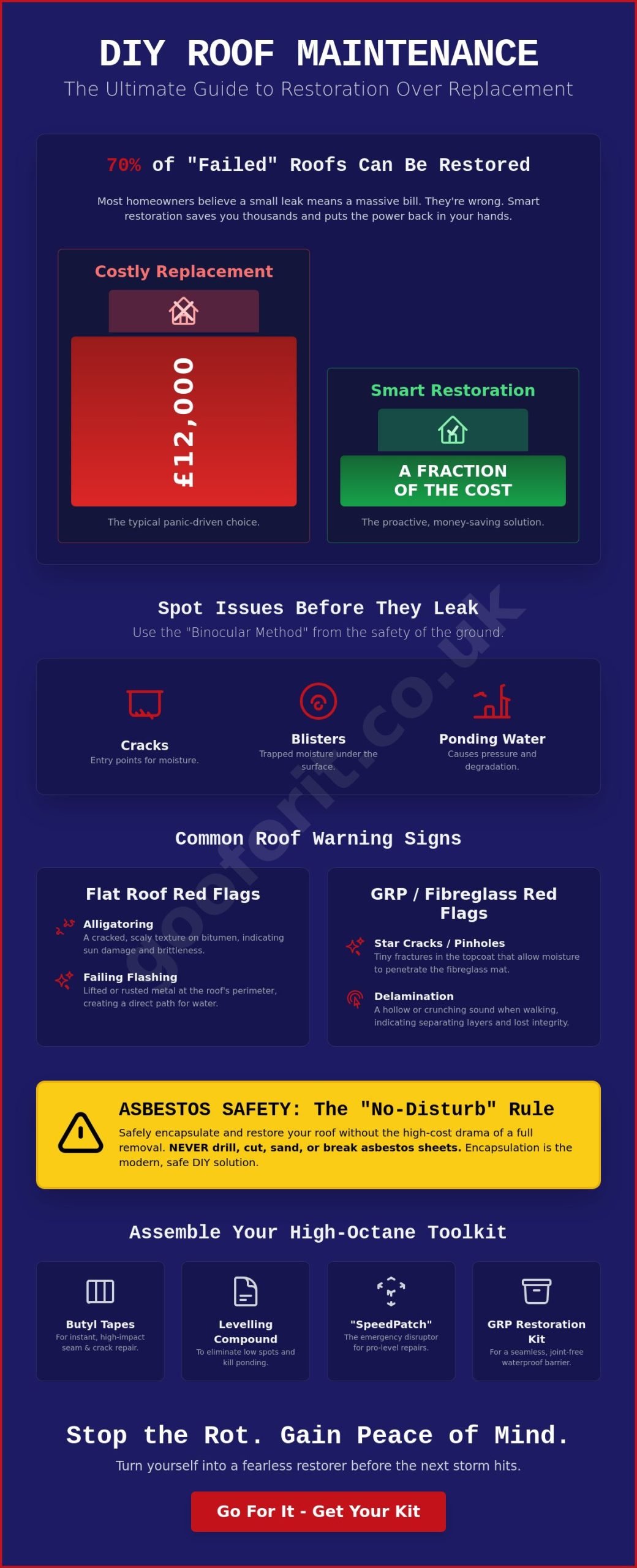
Most UK homeowners believe a single damp patch means a £12,000 replacement bill is inevitable. They’re wrong. You’re tired of the jargon-heavy sales pitches and the paralyzing fear of falling through a fragile deck. We get it. That’s why we’ve built the ultimate guide to DIY roof maintenance tips that cut through the noise and put the power back in your hands.
You want a home that stays bone-dry when the February gales hit. You want professional results without the corporate price tag. We agree that restoration beats replacement every single time. This guide promises to help you restore your own roof. You will learn to master GRP and encapsulation while keeping your asbestos safety on point. We’ll show you how to secure results, save a fortune, and gain peace of mind before the next storm cycle. It’s time to stop the rot. Go for it.
Key Takeaways
- Master the “Binocular Method” to spot visual noise and failing structures from the safety of the ground before the leaks start.
- Remove the ponding on flat roofs by disrupting debris backups that turn a single leaf into a structural nightmare.
- Learn the “No-Disturb” rule for asbestos sheets to safely encapsulate and restore your roof without the high-cost drama of a full removal.
- Discover the essential DIY roof maintenance tips that prove 70% of “failed” roofs can be restored for a fraction of the cost of a replacement.
- Assemble a toolkit featuring the “SpeedPatch” emergency disruptor to handle repairs with confidence and save thousands of pounds.
Roof Inspection Mastery: Spotting the Noise Before the Leak
Stop waiting for the drip. If you’re seeing water stains on your ceiling, you’ve already lost the first round. Real restoration starts with reading the visual noise of a failing system before the chaos begins. Most homeowners ignore the subtle signals until a storm turns a minor crack into a £5,000 structural nightmare. You don’t need to be a pro to spot a dying roof; you just need to pay attention. It’s about being proactive rather than reactive.
Safety is your priority. Forget the ladder for your first pass. Use the Binocular Method. Stand on the ground and scan your roofline. You’re looking for the big three: cracks, blisters, and ponding water. A 10-minute visual sweep after a heavy UK downpour can save you a fortune in emergency call-out fees. While you’re at it, research professional roof cleaning techniques to ensure moss or debris isn’t masking deeper structural issues. This proactive energy is the core of effective DIY roof maintenance tips.
Don’t let the weather dictate your schedule. In 2026, the tech is better, but the physics of a leak remains the same. Gravity always wins. By identifying issues in the dry, you prevent the panic of the wet. Maintenance isn’t about luck; it’s about observation. Look for disruptions in the texture. Any change in the uniform look of your roof is a signal that something is shifting beneath the surface.
The Flat Roof Warning Signs
Flat roofs are notorious for silent failures. Look for alligatoring in your bitumen. This cracked, scaly texture means the sun has baked the life out of your membrane. ISpot the low spots where water pools. Ponding creates immense pressure and accelerates degradation. Check your perimeter too. Flashing is usually the first line of failure. If it’s lifting or rusted, your roof is wide open to the elements. These are the essential DIY roof maintenance tips that separate the survivors from the flooded.
GRP and Fibreglass Red Flags
Fibreglass is tough, but it isn’t invincible. Look for star cracks or tiny pinholes in the topcoat. These are entry points for moisture. If you walk on the surface and hear a hollow, crunching sound, that’s delamination. The layers are separating, and the structural integrity is gone. If you spot these issues, you need to understand the specifics of fibreglass roof problems before you attempt a patch. Don’t let a small vibration become a collapse. Spot the noise, act fast, and keep your structure solid.
Flat Roof Maintenance: Removing the Ponding Water
Ponding water is the ultimate silent killer. It sits. It weighs down your structure. It invites rot. A flat roof should never be a swimming pool. You need to stop this cycle before the damage becomes permanent. Start with the debris. A single soggy leaf can act like a dam during a downpour. Clear it out. You need effective drainage to handle the 1,000mm of rain that parts of Britain experience annually. If your gutters are choked, your roof is effectively drowning. This isn’t just maintenance; it’s a rescue mission for your home.
The Gutter Challenge is real. When the sky opens up, your drainage system needs to perform like a high-flow exhaust. Check the outlets. Clear the silt. Ensure the flow is unobstructed. Most homeowners ignore the corners, but that is where the stagnation starts. These DIY roof maintenance tips are designed to give you the confidence to take control. Don’t wait for a drip in the living room to tell you there’s a problem on the deck. Get up there. Clear the path. Let the water move.
Eliminating Low Spots
Find the dip. Use the “Bucket Test” to be certain. Pour five litres of water on the suspected area. If that water is still hanging around after 48 hours, you have a genuine low spot. Use a dedicated levelling compound to fill the void and restore the fall. Long-term fixes require substance. Quality coatings win because they integrate with the roof surface rather than just sitting on top. It’s about creating a smooth, consistent slope that directs every drop toward the exit.
Sealing Joins and Seals
Seams are the weak points where traditional roofs fail. Old-school felt patches are not effective. They crack, they peel, and they eventually leak. Switch your strategy to butyl tapes for instant, effective seam repair. It’s sticky, it’s flexible, and it holds. GRP restoration is a seamless waterproofing membrane that bonds directly to the substrate to provide a continuous, joint-free barrier. This modern approach eliminates the leak paths that plague older installations. It turns your roof into a single, impenetrable shield against the elements. If you want to elevate your home’s protection, you can start your restoration journey with the right mindset. Stop the leaks. Make some noise. DIY roof maintenance tips are your toolkit for a fearless 2026. Go for it.
Asbestos and Specialist Surface Care: Fearless DIY Maintenance
Stop the panic. That grey corrugated roof isn’t a death sentence. It’s an encapsulation opportunity. If your garage or shed was built before 1999, it likely contains chrysotile. Don’t spend £5,000 on a professional removal team. Encapsulate it yourself. This is the heavy hitter of DIY roof maintenance tips. You aren’t just fixing a leak. You’re securing your home’s future with total confidence.
The “No-Disturb” Rule is your new mantra. Never scrape. Never power wash. Never use a wire brush. Friction is the dangerous because it releases fibres. We want zero noise and zero dust. You want to lock those fibres down under a high-performance barrier. If the sheets are intact, they are safe. Your mission is to keep them that way while making them watertight.
The Encapsulation Strategy
Encapsulation is the gold standard for DIY asbestos care. You don’t remove the problem; you seal it. This creates a seamless, airtight shield that prevents fibre release for years. Start by choosing a high-quality asbestos roof repair kit designed to bond with fibre cement. Preparation is everything. Use a low-pressure garden hose to dampen the surface. This prevents any loose particles from catching the air. Use a soft sponge to wipe away grime. No abrasion allowed.
Safety Gear and Prep
Get the PPE. Wear Type 5/6 disposable coveralls to keep your clothes clean. Use an FFP3 rated mask. It’s the only filter that counts. Add nitrile gloves and eye protection to complete the suit. You want zero exposure. Total safety. Total control.
- Waste Management: Never throw old repair materials in your domestic bin. It’s illegal in the UK.
- Double Bagging: Use 1000-gauge polythene bags. Seal them with duct tape.
- Labelling: Mark every bag with “Asbestos” in bold letters.
- Disposal: Contact your local UK council to find a licensed hazardous waste site.
For a deep dive into the protocols that keep you safe, follow the HSE Guidelines. Once the safety is locked in, finish the job with a specialist solar-reflective paint. This doesn’t just look sharp. It adds 10+ years of life to your roof by blocking UV degradation. You’ve turned a liability into a high-performance asset. Go for it.
The Ultimate DIY Roof Maintenance Toolkit
If you want a roof that survives the 2026 climate, you need professional-grade solutions. That starts with the SpeedPatch. It’s the emergency solution every homeowner needs in their shed. When a leak hits at 2 AM, you don’t call a contractor; you deploy the patch. It’s a high-viscosity, instant-seal solution that stops the chaos before it becomes a flood.
High-performance coatings are for survival. These DIY roof maintenance tips are about creating a seamless, waterproof membrane that moves with your building. Stocking up on these kits before the clouds turn grey is the only way to stay ahead of the curve. Waiting for the rain to start is not a sensible move. You want to be the person with the solution ready to go, not the one scrolling for help while the ceiling drips.
Essential Hardware
Precision matters. Use soft-bristle brushes for detailed flashing and tight corners where a roller can’t reach. Switch to heavy-duty, long-pile rollers for the main deck to ensure coverage. You need industrial-grade cleaning agents that leave zero residue. Any leftover film will kill your adhesion and ruin the bond. Use a laser measurer to calculate your exact square footage. Getting your coverage rates perfect ensures the chemistry works exactly as designed. Aim for the manufacturer’s specified litres per m² to optimise for a 10-year plus lifespan.
Selecting the Right Coating
Match the chemistry to the substrate. GRP is great for flat roofs, offering a rigid, glass-reinforced finish. Bitumen-based solutions provide rugged reliability for traditional felt surfaces. Your choice must include 100% UV resistance. The UK sun is becoming more intense; your roof shouldn’t bake or crack under pressure. Check out this GRP Roof Restoration Coating guide to nail your product selection. It’s the difference between a 2-year fix and a 20-year shield. Look for coatings that offer at least 200% elongation to handle the thermal expansion of a typical British summer.
Ready to make some noise on your next project? Grab your gear and Gooforit today.
Restoration vs. Replacement: Go For It and Save Thousands
Stop listening to the “rip it off and start over” crowd. The truth is that 70% of roofs deemed “failed” by traditional contractors are actually prime candidates for restoration. You don’t need a £12,000 structural replacement when a high-performance coating does the job for a fraction of that cost. These DIY roof maintenance tips aren’t just about cleaning gutters. They’re about financial success. You’re disrupting the typical decay cycle and keeping your cash where it belongs.
Calculating the ROI is simple math. A professional replacement involves skips, scaffolding, and massive labour costs. Restoration cuts those variables out. You’re investing in the product, not a contractor’s overheads. It’s a decision that protects your property value without the large invoice. Don’t let a small crack turn into a structural disaster. Act now to keep your home bone-dry and your bank balance healthy.
Extending Roof Life by a Decade
Maintenance isn’t a chore. It’s a “forever roof” strategy. By applying a high-grade coating, you effectively freeze time for your roof. A single application of a pro-grade GRP-coated system can extend the lifespan of your flat roof by up to 25 years. This is the Goo For It philosophy in action. You take control. You own the protection. You stop being a victim of the British weather and increase your home’s resilience.
Restoration is also the best green move for 2026. Every year, UK landfills swallow millions of tonnes of roofing waste. Don’t add to the pile. Restoring your existing surface keeps materials out of the skip and slashes the carbon footprint of your home. It’s sustainability that saves you money. It is a move that feels good and looks even better.
Your Next Steps
Stop overthinking. Start doing. Action creates momentum. These DIY roof maintenance tips only work if you get off the ladder and get to work. Follow these steps to secure your home:
- Audit your roof this weekend: Use our inspection checklist to look for the weak spots.
- Pick your project: Start with the most urgent leak or that annoying low spot where water pools.
- Seal the deal: Apply your coating when the weather window opens.
The actions are simple. Identify the problem. Fix it before it grows. You have the tools and the expertise is right here. Grab your pro-grade DIY repair kit and get started!
Save your roof now
The 2026 roofing landscape isn’t for the faint-hearted. It’s for the doers who see a ponding vibe and kill it before it becomes a structural disaster. You’ve mastered the inspection noise. You’ve identified the massive gap between a £300 restoration and a £10,000 full replacement bill. Now, it’s time to execute. Specialist GRP and asbestos surfaces don’t need a corporate contractor. They need your focus and our pro-grade coatings. These DIY roof maintenance tips are your blueprint for saving thousands while building something that lasts. We’ve taken our Gloucestershire-born expertise and packed it into kits that deliver nationwide across the UK. No fluff. No filler. Just effective protection designed for your hands.
Your roof is the shield for your property. Don’t let it fade into the background. The tools are ready when you are. Stop watching the rain and start winning the weather game today. Grab your high-performance DIY roof repair kit and Goo For It! You’ve got the vision, we’ve got the gear, and the results will speak for themselves.
Frequently Asked Questions
Can I really repair my own roof if I have no experience?
Yes, you can absolutely tackle basic repairs. Start with low-risk tasks like replacing a slipped slate or clearing blocked gutters to build your skills. Data from 2024 shows that 15% of UK homeowners now handle their own minor exterior fixes to avoid the £300 average professional call-out fee. Grab your tools and go for it. Confidence comes from action.
Is it safe to walk on a flat roof for maintenance?
Safety depends entirely on the roof structure and its load-bearing capacity. Most modern UK residential flat roofs are designed for occasional maintenance access, but you should always check for “non-fragile” ratings under ACR(M)001:2014 standards. Use crawl boards to distribute your weight evenly across the joists. Stay focused, avoid the edges, and keep your gear organised to prevent trips.
How often should I perform DIY roof maintenance?
Inspect your roof at least twice a year. Schedule these checks in early spring and late autumn to catch damage before the winter peak. UK weather is notoriously unpredictable, and 40% of roof failures stem from neglected debris. Following consistent DIY roof maintenance tips like clearing moss every 6 months prevents tile displacement. Stay ahead of the noise before a small drip becomes a flood.
What is the best time of year to apply roof coatings?
Late spring and summer provide the perfect window for restoration. You need a dry spell with temperatures consistently between 10°C and 25°C for the coating to cure properly. Avoid the 155 rainy days the UK averages annually. Applying coatings in damp conditions ruins the chemical bond. Wait for a clear 48-hour forecast to ensure your work has maximum impact.
How do I know if my roof needs a patch or a full restoration?
Assess the total area of damage to make the call. If more than 25% of your tiles are cracked or the underlying felt has disintegrated, you need a full restoration. A single, isolated leak is usually a simple patch job. If your energy bills jumped 10% due to heat loss through the roof, it’s time to go big with a full upgrade.
Can I apply waterproof paint over an old, damp roof?
Never apply waterproof paint to a damp surface. Trapped moisture causes the paint to blister and peel within 12 months, wasting your time and money. Your roof must be bone dry before you start. Use a moisture meter to ensure there is no dampness. Clean the surface thoroughly, let it breathe, and then apply your high-vibe finish for a lasting seal.
Do I need planning permission for DIY roof restoration?
Usually, you don’t need permission for repairs or minor alterations. Under UK Permitted Development rights, you can replace materials if they are similar in appearance to the original house. However, if you change the roof height or use significantly different materials, you must contact your local council. Over 90% of standard home restorations bypass the red tape entirely. Check your local conservation area rules first.
What should I do if I find a major leak during my inspection?
Stop the water entry immediately to protect your interior. Use a heavy-duty tarpaulin and clout nails to create a temporary shield over the breach. Place buckets inside to catch any remaining drips. If the leak covers more than 1 square metre or involves structural timber rot, call in a pro for a consult. Don’t let a major leak ruin your home; secure the site and plan your next move.